Design teams do not struggle with software adoption because they are resistant to technology. They struggle because most plan review software does not solve the actual problem.
I have worked on the engineering, private-provider, inspection, and permitting sides of construction. What I have consistently seen is that many platforms promise to save time but end up creating another administrative process for the design team to manage.
Most software creates more work
A design team may upload its plans into a platform, but then someone still has to configure the review, manually tag sheets, interpret vague findings, remove irrelevant comments, transfer the useful comments into another system, and determine whether the software actually identified a legitimate code issue.
At that point, the software has not eliminated work. It has simply changed the type of work being performed.
Architects and engineers are already working through design revisions, owner comments, consultant coordination, permitting deadlines, RFIs, and construction questions. They do not need another platform that requires significant setup and supervision before it produces something useful.
The tool should fit into the team’s existing workflow. The team should not have to redesign its workflow around the tool.
Generic software does not understand construction
Construction drawings are not simply a collection of words and images. They are an interconnected set of plans, details, schedules, calculations, notes, specifications, and code requirements.
A life-safety plan may identify an occupancy and occupant load. The architectural plans show the exit arrangement. The door schedule provides the opening width. The electrical plans show the emergency lighting. The mechanical plans may affect rated assemblies and shaft requirements.
A legitimate plan review requires those items to be evaluated together.
Generic software may identify a keyword or missing note, but it often does not understand the relationship between disciplines, how construction documents are organized, or how a code requirement is actually applied to a building.
That produces false positives, generic comments, and findings that sound technical but are not useful to the designer.
I have seen projects lose weeks because of one missing detail, an inconsistency between two sheets, or a code requirement that was not addressed until the reviewing authority issued comments. Those issues are often small compared with the overall project, but they can still force another submission and another review cycle.
That is why industry-specific knowledge matters.
There is no accountability
The third problem is accountability.
A software platform can generate hundreds of comments, but who is responsible for determining whether those comments are correct? Can the user see the applicable code section? Can the finding be traced back to a specific sheet or detail? Does the comment explain what is wrong and what needs to be corrected?
A black-box answer is not enough in construction.
Architects and engineers are putting their names, licenses, and reputations behind their work. They cannot act on a software-generated comment simply because the software says something may be wrong.
The output must be transparent, traceable, and reviewable by a qualified professional.
What Makes Plancheckpro.ai Different?
We built PlanCheckPro.ai from the perspective of people who actually review plans, work with building departments, respond to code comments, perform inspections, and help projects get permitted.
It was not built as a generic artificial-intelligence platform that was later adapted for construction. It was developed around the actual plan-review process.
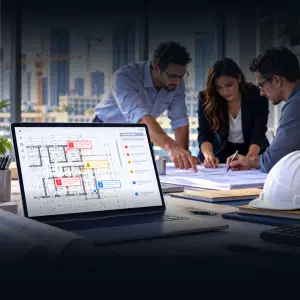
The user uploads the construction documents, and the platform evaluates the drawings for potential compliance issues involving the applicable building codes and standards. The findings are delivered as organized comments with specific code citations and corrective direction that a design professional can review and act on.
The results can also be exported into Excel, which allows teams to assign comments, track responses, coordinate revisions, and incorporate the findings into their existing quality-control process.
The difference is that PlanCheckPro.ai is intended to produce actionable information—not simply more information.
It is also not intended to replace the architect, engineer, plans examiner, or building official. It serves as an additional quality-control review before the plans reach the permitting authority or the construction site.
That distinction is important. Artificial intelligence should support professional judgment, not pretend to replace it.
The greatest value is catching issues earlier. An issue identified while the plans are still being coordinated is usually much easier and less expensive to correct than an issue discovered during permitting or construction.
For design teams, that can mean:
- Fewer avoidable permitting comments.
- Fewer repeated manual reviews after revisions.
- Better coordination between disciplines.
- Fewer RFIs during construction.
- More consistent internal quality control.
- Faster and more predictable permitting.
- Greater confidence before a plan set is submitted.
The real test of any plan review platform is not how impressive the technology sounds. The test is whether the design team receives a reliable, understandable, and actionable review that helps move the project forward.
That is the problem PlanCheckPro.ai was created to solve.