What AI Plan Review Software Works Best for Mid-Sized Engineering Firms?

The best AI plan review software for a mid-sized engineering firm is not necessarily the most expensive or technically complicated platform. It is the one that helps the firm review more projects, maintain consistent quality, and identify potential code issues without requiring additional staff, a dedicated compliance department, or a major IT implementation. Mid-sized firms operate in a difficult position. They manage complex projects and face many of the same quality-control expectations as national firms, but they do not always have the staffing, technology budgets, or specialized internal resources available to larger organizations. PlanCheckPro.ai was designed to help close that gap. The Challenge Facing Mid-Sized Engineering Firms Mid-sized engineering firms are often managing multiple projects, clients, offices, disciplines, and jurisdictions at the same time. They may have experienced engineers and project managers, but those professionals are already responsible for design, calculations, coordination, client communication, field issues, and project delivery. Adding a complete manual code compliance review to every project can create a major bottleneck. They do not have the headcount for manual review bottlenecks A large firm may have a dedicated quality-control group, internal code specialists, or several senior employees available to review drawings before submission. A mid-sized firm often relies on the same senior engineers who are already designing and managing the work. That creates a difficult choice. The firm can delay the submission while waiting for an experienced reviewer to become available, or it can move forward with a limited review to maintain the schedule. Neither option is ideal. I have seen qualified professionals working late or over the weekend to complete reviews because the project schedule did not allow enough time for a thorough manual check. The issue was not a lack of ability. The issue was capacity. When experienced professionals spend hours performing repetitive checks across large drawing sets, they have less time available for engineering judgment, client service, staff development, and resolving complex project issues. AI plan review helps firms increase their review capacity without immediately increasing their headcount. They are working across multiple jurisdictions Building-code requirements are based on adopted codes, but permitting procedures, local amendments, interpretations, submittal requirements, and enforcement practices can differ between jurisdictions. A firm may be working in several cities or counties at the same time. One project may be reviewed by a municipal building department, another by a county, and another through a private-provider process. Project teams must understand not only the technical requirements but also how each jurisdiction expects those requirements to be documented. Many mid-sized firms do not have a full-time code compliance specialist available for every project. Instead, project engineers must research the applicable requirements while continuing to perform their normal design and management responsibilities. That makes consistency difficult. A requirement that is familiar in one jurisdiction may be handled differently in another. A team that works primarily in one market may overlook a documentation requirement when it begins working in a new area. PlanCheckPro.ai gives the firm another review layer that can help identify potential compliance issues before the plans reach the reviewing authority. They need strong capabilities without major cost or IT overhead Mid-sized firms need technology that is practical. They generally cannot support a long implementation process, expensive customization, dedicated servers, or a team of employees assigned solely to administer one platform. They need a system that can be incorporated into the existing project workflow without creating another operational burden. The software should allow the team to upload the drawings, receive an organized review, evaluate the findings, and incorporate the results into its normal quality-control process. That is one of the reasons PlanCheckPro.ai is well suited for mid-sized engineering firms. It provides access to automated code compliance review without requiring the firm to build an internal AI system or maintain a large compliance department. A Real-World Application for a Mid-Sized Engineering Firm Consider a mid-sized engineering firm with several active commercial and multifamily projects. The firm has experienced engineers, but the senior staff is already responsible for managing projects, reviewing calculations, coordinating with architects, responding to contractors, and supervising junior employees. Several permit deadlines are approaching at the same time. Traditionally, a senior engineer may need to spend days manually reviewing each drawing set. If multiple projects reach the quality-control stage at once, the review process becomes a bottleneck. The firm may have to delay submissions, shift staff from other assignments, or complete a more limited review than it would prefer. With PlanCheckPro.ai, the project team can upload the construction documents before permit submission. The platform reviews the drawings and produces organized findings identifying potential code issues, missing information, and inconsistencies that require professional evaluation. The engineering team can then: Review the findings. Confirm which comments apply. Assign items to the appropriate discipline. Correct the plans before submission. Export the results into Excel for tracking. Re-run the review when revised documents are prepared. This allows the senior engineer to focus attention on the conditions that require engineering judgment rather than spending most of the review period searching through drawings for routine issues. The result is not the elimination of professional review. It is a more efficient use of professional review time. Why Mid-Sized Firms Should Use AI Plan Review It expands review capacity AI allows a firm to perform an additional level of quality control without immediately hiring more senior reviewers or creating a separate compliance department. This is especially valuable when several major submissions occur during the same period. It reduces dependence on one person Many firms have one senior employee who becomes the internal resource for difficult code questions. That person can quickly become a bottleneck. PlanCheckPro.ai helps distribute the initial review process across the organization while still allowing the experienced professional to evaluate the final findings and make the necessary decisions. It supports consistent quality across projects Different project managers and offices may have different review habits. An automated review process helps the firm apply a more consistent quality-control standard across projects, teams, and locations. That consistency becomes increasingly
Which AI Plan Review Software Do Architecture Firms Use?

Architecture firms are beginning to use AI plan review software as an additional layer of quality control before drawings are issued for permitting or construction. The best platform is not necessarily the one that generates the most comments. It is the one that understands construction documents, identifies meaningful compliance issues, provides verifiable code citations, and fits into the design team’s existing workflow. That is where PlanCheckPro.ai is different. PlanCheckPro.ai is designed specifically for architects, engineers, contractors, developers, private providers, and other professionals involved in reviewing construction documents. It helps design teams identify potential code violations, missing information, and coordination issues before those problems reach the building department or the construction site. Why Architecture Firms Need AI Plan Review Architectural design is an iterative process. Plans are constantly changing in response to owner decisions, consultant coordination, budget adjustments, constructability concerns, and building department comments. Every change can affect code compliance. Moving a wall may affect an accessible route. Changing a door may affect egress capacity, maneuvering clearance, fire ratings, or hardware requirements. Reclassifying a room may affect occupant load, plumbing fixture counts, ventilation, fire protection, and separation requirements. The design change itself may take only a few minutes. Fully evaluating every code-related consequence of that change can take much longer. Design revisions happen constantly A construction drawing set is rarely reviewed once and then left unchanged. Architecture firms may issue multiple versions during schematic design, design development, permit submission, permit resubmission, bidding, and construction. Each revision must be coordinated across architectural, structural, mechanical, electrical, plumbing, fire-protection, and life-safety documents. The problem is that manual re-checking cannot always keep pace. Under a deadline, the team may focus on the sheets that were intentionally revised. However, a change on one sheet can create an inconsistency somewhere else. For example, a floor plan may be revised to relocate a door, while the life-safety plan, door schedule, electrical plan, hardware schedule, or rated-wall detail remains unchanged. The original design may have complied, but the revised set may now contain a conflict. That is how many permit comments and construction RFIs are created—not because the design team lacks experience, but because the volume and pace of changes make complete manual coordination extremely difficult. Architects are responsible for compliance but cannot specialize in every code issue Architects are trained to integrate design, function, safety, constructability, aesthetics, client requirements, and regulatory compliance. However, modern building codes are too extensive for any one person to specialize equally in every discipline and every requirement. A project may involve: Building and life-safety requirements. Accessibility standards. Structural provisions. Fire-resistance requirements. Mechanical, electrical, and plumbing codes. Energy requirements. Fire-protection standards. Local amendments and jurisdiction-specific procedures. Numerous referenced standards. An architect may be responsible for coordinating the overall documents, but the project also depends on multiple consultants, each producing information that affects other disciplines. AI plan review gives the architect another quality-control resource. It does not replace the architect’s knowledge or professional judgment. It helps the architect evaluate a larger volume of information more consistently. Permitting delays directly affect client relationships Clients do not separate the design process from the permitting process. From their perspective, both are part of the architect’s responsibility to move the project forward. When drawings receive avoidable code comments, require repeated resubmissions, or remain in review longer than expected, the client experiences a delay. That delay may affect: Financing. Contractor mobilization. Material procurement. Tenant commitments. Lease commencement dates. Construction schedules. Project carrying costs. Revenue projections. Even when the building department’s review time is outside the architect’s control, clients still judge the design team by how prepared the plans were when submitted and how quickly comments are resolved. Repeated permitting issues can damage confidence in the firm. A clean, coordinated submission strengthens the client relationship and demonstrates that the design team has a serious quality-control process. A Real-World Application for a Design Team Consider a typical multifamily or commercial project approaching its permit submission deadline. The architectural team has completed its internal review. The engineering consultants have issued their latest drawings. The owner has made several late design changes, and the team is working under pressure to submit the package. Traditionally, the project architect or quality-control reviewer would manually move through hundreds of sheets, checking life safety, accessibility, rated assemblies, door information, schedules, details, and consultant coordination. Because of the deadline, the reviewer may have only a few days to complete work that could reasonably require much longer. With PlanCheckPro.ai, the design team can upload the coordinated drawing set for an additional review before submission. The platform can help identify conditions such as: Inconsistent room names or uses across disciplines. Differences between life-safety plans and architectural plans. Missing or inconsistent fire-resistance information. Door widths or arrangements that may not support the required egress. Accessibility information that is missing or incomplete. Conflicts between plans, schedules, notes, and details. Potential code requirements that are not clearly addressed. Changes that may have affected previously compliant conditions. The design team then receives organized findings with code references and corrective direction. The architect reviews those findings, determines which comments are applicable, assigns them to the appropriate consultant, and corrects the plans before submission. The value is not that AI makes the final design decision. The value is that it gives the team another opportunity to catch issues while the drawings are still under its control. Why Architecture Firms Should Use AI Plan Review AI plan review should become part of the firm’s internal quality-control process—not something used only after a project has already encountered permitting problems. Faster reviews AI can analyze large drawing sets significantly faster than a fully manual review. This allows the design team to perform additional reviews without adding several days to the schedule. Better revision control Revised drawings can be reviewed again without requiring the quality-control team to manually restart the entire process. This is especially important when revisions occur shortly before submission or when several permit resubmissions are required. More consistent quality control The same review criteria can be applied
How Do AI Plan Review Platforms Speed Up Code Compliance Checks?
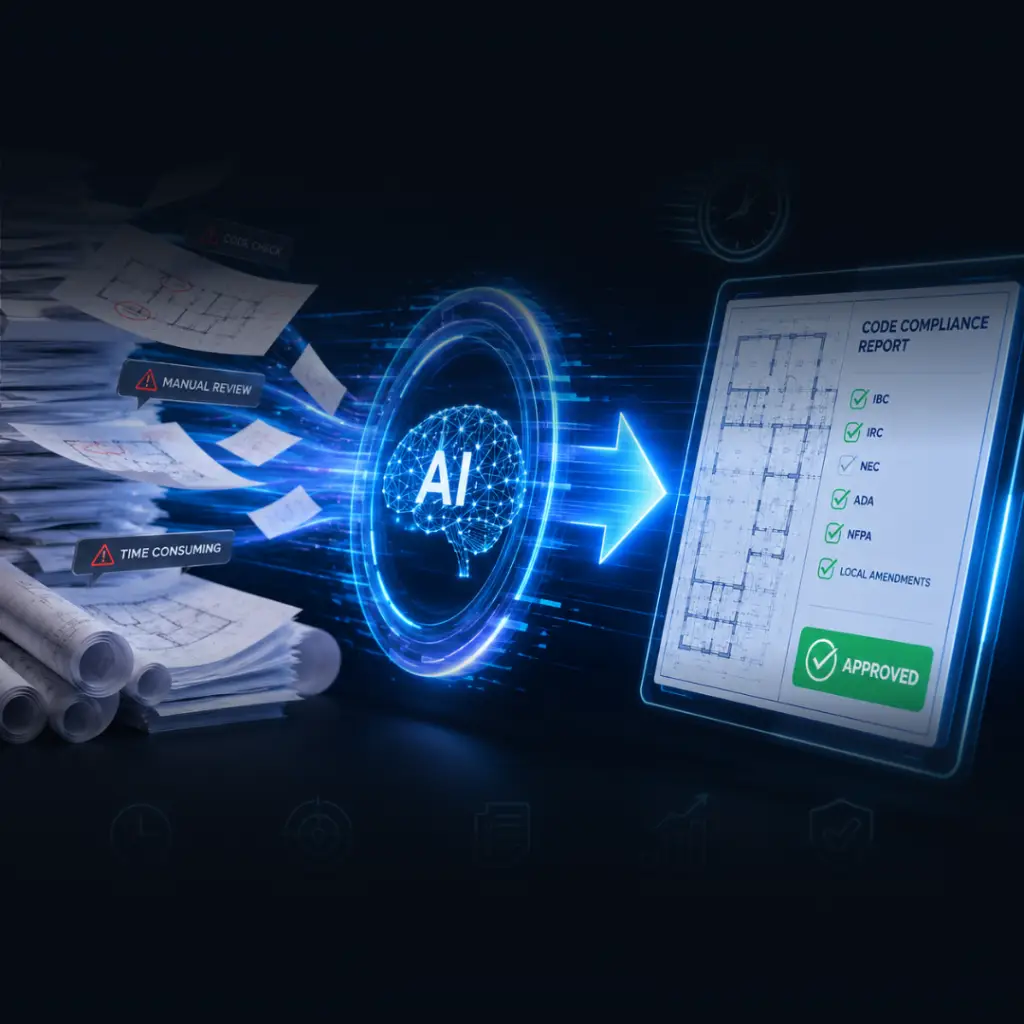
Traditional plan review is slow because it depends on a qualified person manually moving through hundreds of drawing sheets, locating relevant information, cross-referencing details, applying code requirements, and documenting every potential issue. AI plan review platforms accelerate that process by analyzing the drawing set as a whole rather than requiring the reviewer to evaluate each sheet and condition one at a time. They review complete drawing sets in minutes instead of days A comprehensive manual code review can take days, depending on the size and complexity of the project. Large commercial and multifamily projects may contain hundreds of architectural, structural, mechanical, electrical, plumbing, fire-protection, and life-safety sheets. The reviewer must locate critical project information, including: Occupancy classifications. Construction types. Building heights and areas. Fire-resistance ratings. Occupant loads. Exit locations and capacities. Accessibility requirements. Plumbing fixture calculations. Mechanical and electrical system information. An AI platform can process the drawing set and begin identifying potential compliance issues in a fraction of the time required for a fully manual review. This does not mean the architect or engineer should accept every result without evaluation. It means the professional receives a structured first review much faster and can focus attention on the conditions that require judgment. They cross-reference drawings automatically One of the most time-consuming parts of manual plan review is comparing information across different sheets and disciplines. A reviewer may need to compare a floor plan with a life-safety plan, door schedule, wall-type detail, reflected ceiling plan, electrical plan, and fire-protection drawing to determine whether one condition complies. AI can assist by identifying and comparing related information throughout the drawing set. For example, the platform may identify that: A fire-rated wall shown on one sheet is not consistently identified elsewhere. A door width does not appear to support the required exit capacity. A room name or occupancy designation differs between plans. A required accessibility feature is missing from the related details. A penetration through a rated assembly lacks an appropriate detail. The occupant load does not appear consistent with the number or width of exits. Instead of requiring someone to repeatedly move between sheets and remember every related condition, the system helps organize and surface those potential conflicts. They re-check revisions without restarting the entire process Design documents change constantly. A building department comment may require a revised floor plan. An owner may change the use of a space. A consultant may relocate equipment. A revised wall or door location may affect egress, accessibility, fire ratings, or coordination with other disciplines. During a traditional revision review, the reviewer must determine what changed, confirm whether previous comments were addressed, and evaluate whether the revisions created additional issues elsewhere. AI plan review platforms can process the revised documents and repeat the compliance analysis without requiring the reviewer to manually restart the entire review. This is especially valuable on projects with multiple submission cycles. The design team can evaluate each revised set before resubmitting it, reducing the likelihood that one correction creates another problem. How Does PlanCheckPro.ai Work? PlanCheckPro.ai is designed to provide architects, engineers, contractors, developers, and code professionals with an additional quality-control review of construction documents. The process is straightforward: The user uploads the construction drawing set. PlanCheckPro.ai analyzes the drawings against applicable building codes and standards. The system reviews information across multiple sheets and disciplines. It identifies potential code violations, missing information, and coordination issues. The user receives organized comments with code citations and corrective direction. The results can be exported into Excel for review, assignment, response, and tracking. Revised plans can be uploaded and reviewed again before the next submission. The design professional remains responsible for evaluating the findings and determining the appropriate correction. PlanCheckPro.ai supports professional judgment; it does not replace it. What Makes PlanCheckPro.ai Stand Out? There are many products using artificial intelligence, but construction code review requires more than a general-purpose AI model. PlanCheckPro.ai was developed around the way construction documents are actually prepared, coordinated, reviewed, and submitted for permits. It is construction-specific Generic AI may understand words appearing on a drawing, but it may not understand how construction information is connected. PlanCheckPro.ai is designed to evaluate construction drawings using building-code and plan-review logic. It recognizes that compliance information may be distributed across plans, schedules, notes, calculations, and details. That industry-specific focus helps produce findings that are more relevant to architects, engineers, contractors, and code professionals. It provides code citations and corrective direction A vague warning is not useful to a design team. The user needs to know what the issue is, where it appears, which code requirement applies, and what should be reviewed or corrected. PlanCheckPro.ai is designed to produce actionable findings supported by applicable code citations. That allows the design professional to verify the requirement and make an informed decision. It fits into existing design workflows Design teams do not need another complicated system that creates more administrative work. PlanCheckPro.ai produces an organized output that can be exported into Excel. Teams can use the results during quality-control meetings, assign comments to consultants, document responses, and track corrections before permit submission. The goal is to support the team’s existing process rather than force the team to completely change how it works. It delivers consistent reviews Human review quality can vary based on workload, experience, fatigue, and available time. PlanCheckPro.ai applies a consistent review process each time a drawing set is analyzed. That gives firms a repeatable quality-control standard across projects, offices, reviewers, and revision cycles. It was built from real plan-review experience My background includes engineering, inspections, private-provider services, permitting, and working directly with building departments and design teams. I have seen projects delayed by issues that were relatively minor but were not discovered until the plans reached the building department. I have also seen revisions intended to resolve one comment create a new conflict somewhere else in the drawing set. PlanCheckPro.ai was created to address those real problems. The purpose is not to generate an impressive volume of comments. The purpose is to identify meaningful issues
What Makes It Hard to Manually Review Construction Drawings for Code Compliance?
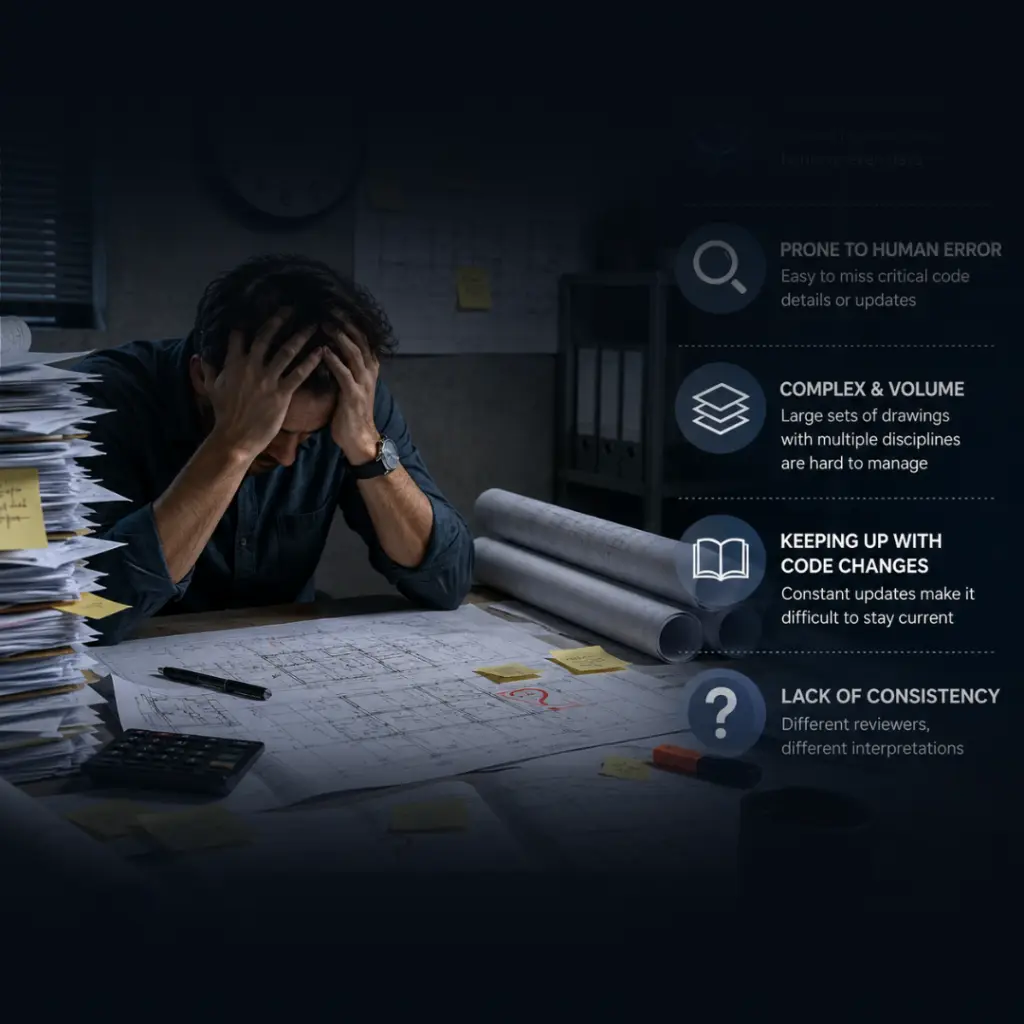
Manually reviewing construction drawings for code compliance is difficult because the reviewer is not checking one isolated requirement. They are evaluating an entire building across multiple disciplines, hundreds of drawing sheets, and thousands of interconnected code provisions. A complete review requires more than knowing the code. It requires understanding how the building is designed, how the different systems work together, and where information may be missing or inconsistent. The volume and complexity of the codes Building codes are extensive and constantly evolving. A single project may require review under the Florida Building Code, fire code, accessibility requirements, electrical code, mechanical code, plumbing code, energy code, and numerous referenced standards. The applicable requirements also depend on factors such as: Occupancy classification. Construction type. Building height and area. Fire-resistance requirements. Occupant load. Means of egress. Accessibility. Structural systems. Mechanical, electrical, and plumbing design. One decision can affect numerous other requirements. For example, changing an occupancy classification can affect the allowable building area, required fire ratings, sprinkler requirements, plumbing fixture counts, occupant load, and means of egress. A reviewer cannot simply check one section of the code and move on. The reviewer must understand how each requirement affects the rest of the design. In my experience, the most difficult code issues are not always obvious violations. They are often small inconsistencies or missing connections between multiple requirements that only become visible when the entire project is evaluated together. Cross-referencing across the drawing set Construction documents are divided across architectural, structural, mechanical, electrical, plumbing, fire protection, civil, and life-safety drawings. The information needed to confirm compliance is rarely located on one sheet. A door may appear compliant on the floor plan, but the reviewer may also need to check: The life-safety plan for the required exit capacity. The door schedule for the clear opening width. The hardware schedule for panic hardware. The wall details for the required fire rating. The electrical plans for exit signs and emergency lighting. The accessibility details for maneuvering clearance and thresholds. The same condition may appear differently on multiple sheets. A wall may be shown as fire-rated on one plan but not identified as rated on another. A room name may change between the architectural and mechanical drawings. A penetration may be shown through a rated assembly without a corresponding firestopping detail. Manually finding those inconsistencies requires the reviewer to move back and forth through a large drawing set while remembering what was shown elsewhere. That is one of the biggest challenges in plan review. The issue is often not that information is completely absent. The issue is that the information does not coordinate across the documents. Human fatigue and inconsistency Even the most experienced reviewer is still human. Reviewing a large drawing set requires intense concentration for long periods. As the review continues, fatigue increases and attention to detail can decline. Repetitive tasks make it easier to overlook an inconsistency, particularly when the same condition appears dozens or hundreds of times. Two qualified reviewers may also approach the same project differently. One may focus heavily on egress and fire-resistance requirements, while another may identify more accessibility or coordination issues. The quality of the review can vary depending on: The reviewer’s experience. The amount of time available. The complexity of the project. The reviewer’s workload. The jurisdiction’s specific requirements. Whether the project is being reviewed for the first time or after revisions. Revision reviews create another challenge. When a design team submits updated drawings, the reviewer must determine what changed, whether the original comments were resolved, and whether the revisions created new compliance issues elsewhere in the set. That process is time-consuming, and it is easy for a change on one sheet to create a conflict with another sheet that was not updated. What Makes PlanCheckPro.ai Different? PlanCheckPro.ai gives the design team an additional level of quality control before the drawings are submitted to the building department. The platform can evaluate the entire drawing set without becoming tired, losing concentration, or changing its review approach from one project to the next. It is designed to help identify potential code issues, missing information, and inconsistencies across the documents. Instead of relying entirely on a reviewer to remember every requirement and manually cross-reference every sheet, the system assists with that repetitive and time-intensive work. PlanCheckPro.ai is different because it was developed around the real construction plan-review process. It does not simply search drawings for keywords. It evaluates construction documents using industry-specific code knowledge and produces organized findings that include the applicable code citation and corrective direction. The output allows the architect, engineer, or quality-control reviewer to understand: Where the potential issue is located. Which requirement applies. Why the condition may not comply. What should be reviewed or corrected. This gives the design professional something actionable rather than a generic warning. PlanCheckPro.ai also helps create consistency. The same review criteria can be applied across every project and every revision, regardless of workload or deadline pressure. The platform does not replace professional judgment. The architect or engineer still determines how the design should be corrected and remains responsible for the final construction documents. What it does is reduce the amount of repetitive manual checking required and give the professional another opportunity to catch issues before they become permit comments, RFIs, delays, or construction changes. From a business standpoint, that is where the value becomes significant. A code issue identified during design may take a few minutes or hours to correct. The same issue discovered after permit submission could delay the project by weeks. If it is discovered during construction, it may require demolition, redesign, additional materials, and change orders. PlanCheckPro.ai helps move the review process earlier, when corrections are faster, less disruptive, and less expensive. The goal is not to eliminate the human reviewer. The goal is to allow the reviewer to focus more time on professional judgment and complex design issues while the technology supports the repetitive, detailed, and time-consuming portions of code compliance review.
PlanCheckPro.AI Receives the 2026 FPEI New Product Award for Engineering Innovation

Recognized by the Florida Professional Engineers in Industry (FPEI) for advancing the future of AI plan review. PlanCheckPro.AI is proud to announce that it has been selected as the recipient of the 2026 Florida Professional Engineers in Industry (FPEI) New Product Award, a prestigious honor presented through the Florida Engineering Society (FES). The award recognizes outstanding engineering innovation and celebrates products that demonstrate technical excellence while making a meaningful impact on the engineering profession, industry, and the public. Developed by engineers for the construction industry, PlanCheckPro.AI is transforming the way construction documents are reviewed by using artificial intelligence to identify code compliance issues before plans are submitted. This recognition reflects the platform’s commitment to improving permitting efficiency, reducing project delays, and supporting better project outcomes through innovative technology. Engineering Innovation That Solves Real Industry Challenges As construction projects become more complex, permitting timelines continue to lengthen, and regulatory requirements become increasingly demanding, design and construction teams need smarter tools to ensure compliance before submission. PlanCheckPro.AI was created to meet that need. The platform performs comprehensive AI plan reviews across multiple disciplines, analyzing construction drawings against applicable building codes and standards while generating detailed compliance reports with precise code references and actionable recommendations. By identifying potential issues early in the design process, architects, engineers, contractors, developers, and building officials can reduce revisions, improve submission quality, minimize costly delays, and accelerate approvals. Today, more than 650 firms across the United States trust PlanCheckPro.AI to streamline plan review workflows and improve project delivery. Recognizing Engineering Excellence The FPEI New Product Award recognizes products that exemplify engineering creativity, innovation, and technical achievement. It honors solutions that demonstrate how engineering can solve real-world challenges while advancing the profession and creating lasting value for industry and society. Receiving this award reinforces PlanCheckPro.AI’s mission to provide practical, engineer-driven technology that modernizes the plan review process without compromising code compliance, quality, or public safety. A Milestone for the Future of Permitting This recognition represents more than an award for a single product. It reflects the growing role artificial intelligence is playing in transforming the construction and permitting industry. As jurisdictions, design professionals, and construction teams continue seeking faster, more accurate, and more efficient review processes, PlanCheckPro.AI remains committed to delivering innovative solutions that help projects move forward with greater confidence. By combining engineering expertise with advanced artificial intelligence, PlanCheckPro.AI is helping shape the future of plan review across the United States. Looking Ahead PlanCheckPro.AI extends its sincere appreciation to the Florida Professional Engineers in Industry and the Florida Engineering Society for this distinguished recognition. We also thank our clients, partners, and the engineering community for their continued trust and support. Their collaboration and feedback have helped drive the innovation behind PlanCheckPro.AI, and we look forward to continuing our mission of delivering faster, smarter, and more reliable plan reviews. The future of plan review is here—and we’re just getting started.
AI and HUD: Officials Nationwide Join PlanCheckPro.AI Webinar to Explore the Future of Automated Permitting

Building Officials, Municipal Leaders, and Industry Professionals Came Together to Learn About HUD’s $3 Million Funding Opportunity Communities across the country are actively looking for new ways to modernize permitting, reduce review times, and improve the customer experience. That growing interest was evident during PlanCheckPro.AI’s recent webinar on the HUD Automated Permitting Systems Demonstration NOFO, which brought together building officials, local government representatives, engineers, and industry professionals from across the United States. The webinar focused on helping attendees understand the opportunities available through HUD’s $3 million funding initiative, designed to support jurisdictions implementing innovative technologies that improve permitting efficiency and accelerate housing development. A Strong Response from Public Sector Leaders The webinar received an outstanding response, with officials from numerous jurisdictions joining to learn how artificial intelligence can support the future of permitting. Participants explored how emerging technologies are helping agencies: Modernize permitting workflows Reduce plan review turnaround times Improve code compliance consistency Increase operational efficiency Better serve developers, design professionals, and their communities The high level of engagement throughout the session reflected a growing national conversation around digital transformation in the public sector. Understanding the HUD Automated Permitting Systems Demonstration NOFO During the webinar, attendees received an overview of HUD’s funding opportunity, including: Program objectives Eligibility requirements Available funding Application process Implementation considerations Potential uses of AI in permitting operations The discussion highlighted how jurisdictions can leverage funding to evaluate and deploy technologies that streamline plan review while maintaining the integrity of the code compliance process. AI Is Transforming the Permitting Process One of the key themes throughout the webinar was the increasing role of artificial intelligence in supporting—not replacing—building officials and plan reviewers. AI-powered plan review enables agencies to identify potential code compliance issues earlier, reduce repetitive manual tasks, and improve consistency across reviews. These tools allow reviewers to spend more time applying professional judgment while technology helps accelerate routine compliance checks. As permitting demands continue to increase nationwide, many jurisdictions are exploring how AI can become an important part of a modern permitting strategy. Thank You to Everyone Who Joined We sincerely thank everyone who participated in the webinar and contributed to an engaging discussion. The thoughtful questions and strong attendance demonstrated the growing commitment among public agencies to explore innovative solutions that improve permitting efficiency and support responsible community growth. The enthusiasm shown by building officials and municipal leaders reinforces what we’re seeing across the industry: jurisdictions are actively seeking practical technologies that help deliver faster, more efficient services while maintaining high standards for safety and code compliance. Continuing the Conversation The HUD funding opportunity represents an exciting step toward modernizing permitting across the country, and PlanCheckPro.AI is proud to support jurisdictions as they evaluate the role AI can play in that transformation. If you were unable to attend the live session, the webinar recording and presentation materials are available to help you learn more about the funding opportunity, application process, and how AI-assisted plan review can support your community’s permitting goals. As more agencies embrace innovation, PlanCheckPro.AI remains committed to helping building departments, municipalities, and industry professionals streamline plan review, improve efficiency, and accelerate project approvals through intelligent, practical AI solutions.
HUD Funding for AI Plan Review: Webinar for Building Officials and Jurisdictions

HUD Opens $3 Million Funding Opportunity for AI Plan Review: Join Our June, 30th Webinar. The U.S. Department of Housing and Urban Development (HUD) has announced a significant new funding opportunity aimed at helping jurisdictions modernize the permitting process through artificial intelligence. Through HUD’s Automated Permitting Systems Demonstration NOFO, eligible jurisdictions may apply for awards ranging from $300,000 to $1.5 million to deploy and evaluate AI powered permitting and plan review technology in active permitting environments. With permitting delays continuing to impact housing production and development timelines across the country, this initiative represents a major opportunity for building departments and local governments looking to improve efficiency, reduce review times, and modernize operations. To help jurisdictions better understand the funding opportunity and the role AI can play in plan review, PlanCheckPro.AI is hosting a live executive webinar on June 30, 2026. Webinar Details HUD Funding for AI Plan Review Date: June 30, 2026 Time: 2:00 PM EDT Presenter: Wesley Foster, PE, SI, MBA Principal Engineer at Pacifica Engineering Services + PlanCheckPro.AI Register Here What We’ll Cover During this webinar, attendees will learn: • Details of HUD’s Automated Permitting Systems Demonstration NOFO • Available funding amounts and application requirements • Key deadlines and eligibility considerations • How AI plan review can improve permitting efficiency • Strategies for reducing review times and accelerating approvals • Real world applications of AI in plan review and code compliance • Best practices for jurisdictions evaluating AI technologies Whether you are actively considering applying for funding or simply exploring ways to modernize your permitting process, this session will provide valuable insight into both the opportunity and the technology available today. Why HUD Is Investing in AI Permitting Permitting remains one of the most significant bottlenecks affecting housing development nationwide. Many jurisdictions continue to face increasing permit volumes, staffing shortages, and growing demands for faster review turnaround times. These challenges can delay projects, increase costs, and slow the delivery of much needed housing. HUD’s investment reflects a growing recognition that technology can help jurisdictions address these challenges more effectively. Artificial intelligence can assist plan reviewers by analyzing construction documents, identifying potential code compliance issues, organizing findings, and generating detailed review reports in a fraction of the time required through traditional manual processes. The goal is not to replace building officials or plan reviewers. The goal is to provide tools that help them work more efficiently while maintaining the high standards of safety and compliance that communities depend on. Why PlanCheckPro.AI PlanCheckPro.AI was developed specifically for the construction and permitting industry. Built by licensed engineers and professionals with real world experience in plan review, permitting, and code compliance, the platform helps identify potential issues before they become permit delays. PlanCheckPro.AI reviews plans against local building codes, NEC, NFPA, and ADA requirements across all 50 states and delivers detailed compliance reports with exact code citations and corrective recommendations. Today, more than 600 firms nationwide are using PlanCheckPro.AI to support faster, more efficient plan review. Application Deadline Jurisdictions interested in applying for funding should be aware that the application deadline is: July 13, 2026 With awards ranging from $300,000 to $1.5 million and only a limited number of awards anticipated, jurisdictions should begin evaluating their options as soon as possible. Join the Conversation We invite building officials, permit directors, municipal leaders, county governments, state agencies, tribal governments, and private providers to join us for this important discussion. Register today and learn how AI plan review can help your jurisdiction prepare for the future of permitting. Register For The Webinar After the Webinar The webinar recording will be made available on this page following the event.
HUD Is Investing in AI for Permitting. Here’s Why That Matters for the Future of Plan Review.
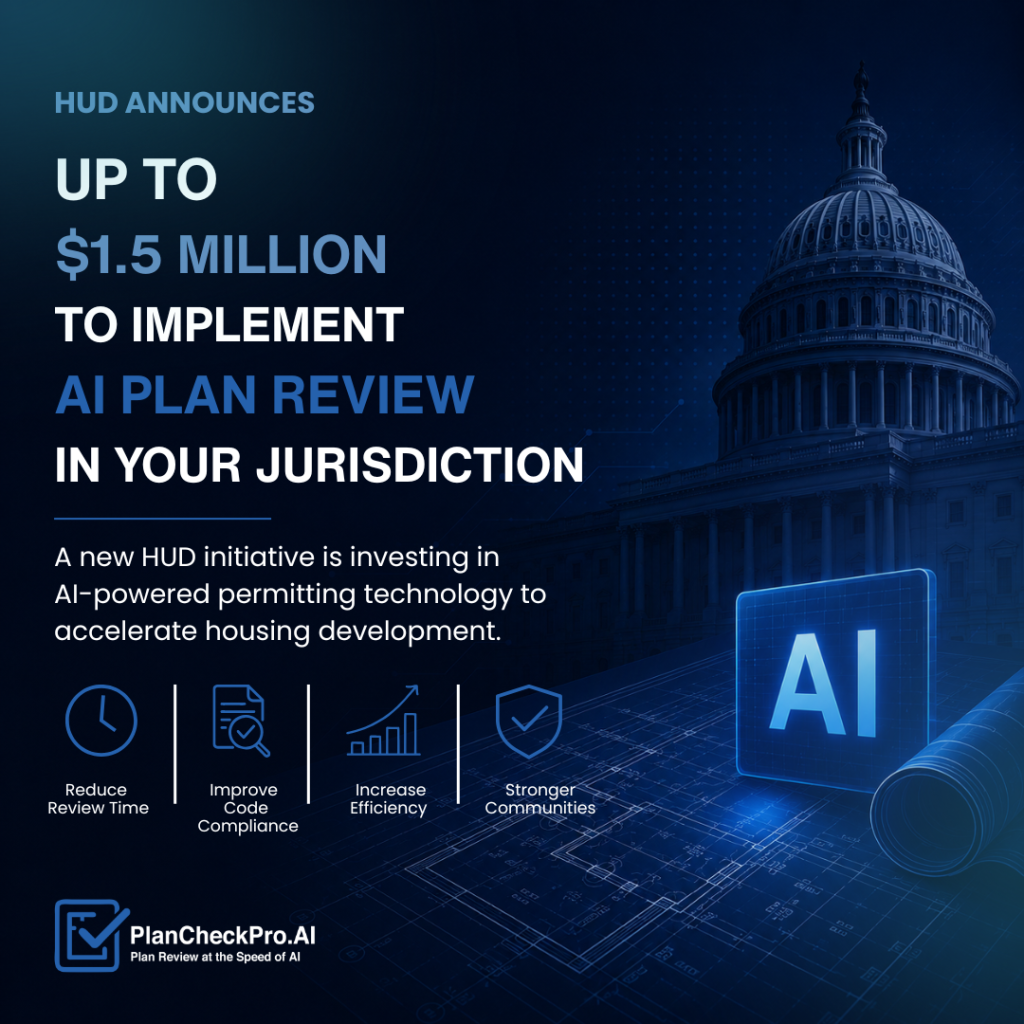
HUD Is Investing in AI for Permitting. Here’s Why That Matters for the Future of Plan Review. The construction industry has spent years searching for ways to address housing shortages, rising development costs, and project delays. Funding programs, zoning reforms, and policy changes have all become part of the conversation. Yet one challenge continues to slow projects before construction even begins: permitting. For developers, architects, engineers, contractors, and building departments, permit delays can have a significant impact on project timelines and budgets. Every week spent waiting for comments or approvals affects financing, scheduling, staffing, and overall project delivery. That is why HUD’s latest announcement is drawing attention across the construction industry. The U.S. Department of Housing and Urban Development recently introduced a $3 million funding opportunity designed to help jurisdictions explore automated permitting technologies and AI driven review processes. The objective is straightforward: accelerate housing production by reducing administrative bottlenecks that slow development. For those of us who work in permitting and plan review every day, this is not a future concept. It is a challenge we have been addressing for years. Why HUD’s AI Initiative Matters HUD’s announcement represents an important shift in how government agencies are approaching the permitting process. As communities continue to grow, building departments are being asked to review increasingly complex projects while managing limited resources and growing workloads. The result is often longer review cycles, multiple rounds of comments, and delays that affect everyone involved in a project. Federal agencies are beginning to recognize that improving the speed and efficiency of permitting is essential to increasing housing production and supporting economic growth. Artificial intelligence has the potential to play an important role in that effort. AI can analyze thousands of pages of construction documents, identify potential code conflicts, organize findings, and generate detailed reports in a fraction of the time required through traditional manual review processes. This allows plan reviewers and building officials to spend more time evaluating solutions, making decisions, and focusing on the issues that require professional judgment. Why We Built PlanCheckPro.AI At Pacifica Engineering Services, we experienced these challenges firsthand. As a firm deeply involved in plan review, inspections, permitting, and construction consulting, we saw how much time was being spent on repetitive code verification tasks. Projects were delayed. Design teams were waiting. Jurisdictions were managing growing review volumes. Rather than accepting those delays as part of the process, we built PlanCheckPro.AI. PlanCheckPro.AI was created specifically to help identify code compliance issues before they become permit delays. The platform reviews construction drawings against applicable codes and generates a detailed compliance report with exact code citations and corrective recommendations. Today, PlanCheckPro.AI is used by architects, engineers, developers, contractors, private providers, and permitting professionals across the country. What Makes PlanCheckPro.AI Different? Many technology platforms focus on permit management or document tracking. PlanCheckPro.AI focuses on the plan review process itself. The platform can: • Review plans against local building codes • Analyze compliance with NEC requirements • Check ADA accessibility standards • Review NFPA life safety requirements • Evaluate multiple disciplines from a single submission • Generate detailed compliance reports with code references • Deliver results the same day Instead of discovering potential issues weeks into the review process, project teams can identify concerns early and address them before plans are submitted for approval. The result is fewer review cycles, fewer corrections, and a faster path to permit approval. Up to $1.5 Million in Federal Funding Is Available HUD’s Automated Permitting Systems Demonstration NOFO is providing a unique opportunity for jurisdictions interested in implementing AI plan review technology. The program is making $3 million available to support real world deployment of AI powered permitting solutions. Six awards will be granted to eligible jurisdictions, with funding requests ranging from $300,000 to $1.5 million. Eligible applicants include: • State governments • County governments • Municipal governments • Federally recognized tribal governments Jurisdictions must propose the deployment and evaluation of AI plan review technology within an active permitting environment. The application deadline is July 13, 2026. For jurisdictions considering applying, PlanCheckPro.AI was built specifically for this purpose. Unlike general AI platforms adapted for construction, PlanCheckPro.AI was developed by licensed engineers, plan reviewers, and building professionals with years of experience inside the permitting process. The platform reviews plans against local building codes, NEC, NFPA, and ADA requirements across all 50 states. It provides same day compliance reports with exact code citations and corrective actions and is already being used by building departments and leading AEC firms nationwide. Our team is actively working with jurisdictions interested in pursuing this funding opportunity and can help support the technical planning and implementation strategy needed for a strong application. If your jurisdiction is exploring AI plan review and considering applying for HUD funding, we would welcome the opportunity to discuss how PlanCheckPro.AI can support your goals. The funding is available. The technology is ready. The opportunity to modernize plan review is here. To learn more about partnering with PlanCheckPro.AI or to discuss your application strategy, contact our team today.
The Future of AI Plan Review is Here

PlanCheckPro.AI was built to help architects, engineers, developers, contractors, building officials, and project owners identify code compliance issues before plans are submitted, reducing delays, minimizing revisions, and accelerating project timelines. GET FREE ACCESS TODAY
How AI Is Reshaping the Way Projects Move from Design to Approval

How AI Is Reshaping the Way Projects Move from Design to Approval There is a moment in almost every project when the excitement of design meets the reality of approval. The drawings are moving. The team is aligned. The owner is ready. Then the project enters plan review, and suddenly everything slows down. Sometimes the comments are expected. Sometimes they are small but time-consuming. Other times, they reveal issues that should have been caught weeks earlier. A missing accessibility detail. A code conflict. A coordination issue between disciplines. A requirement that changed from one jurisdiction to another. That is where AI is beginning to change the process. Not by replacing architects, engineers, or reviewers, but by helping project teams catch problems earlier, before they become expensive delays. For years, construction has struggled with productivity, cost pressure, and fragmented workflows. McKinsey has reported that construction costs have continued rising above general inflation in many markets, while productivity remains a persistent industry challenge. At the same time, permitting and approvals have long been one of the hardest parts of the construction process to manage. AI plan review gives teams a faster way to check drawings before submission. Instead of waiting weeks to find out what needs to be corrected, teams can identify many code-related issues in hours. For architects, that means fewer surprises.For developers, it means better schedule control.For contractors, it means fewer downstream conflicts.For municipalities, it means cleaner submissions and more focused reviews. PlanCheckPro.AI was built for that exact reason: to help projects move from design to approval with more clarity, more speed, and fewer avoidable setbacks. Ready to see how AI can help your next project move faster? Request free access today.