Architecture and engineering firms are under pressure to deliver coordinated construction documents faster while managing complex building codes, multiple disciplines, frequent revisions, and demanding permit schedules.
AI construction plan review software can help firms strengthen quality control by analyzing construction documents, identifying potential code compliance issues, cross-referencing information across drawings, and supporting teams before permit submission.
But not every AI plan review platform works the same way. For A&E firms, the right solution should understand construction documents, provide actionable findings, fit into existing workflows, and support—not replace—professional judgment.
AI construction plan review software uses artificial intelligence to analyze construction drawings for potential building code, coordination, and documentation issues.
Instead of requiring a reviewer to manually search through every drawing and repeatedly cross-reference plans, schedules, details, and notes, AI can assist with repetitive portions of the review.
Depending on the platform, automated code compliance review may evaluate information related to:
AI plan review is not intended to replace architects, engineers, plans examiners, or building officials. It provides an additional quality-control layer that allows qualified professionals to focus more of their time on issues requiring professional judgment.
Construction documents are interconnected. A reviewer is rarely checking one requirement on one sheet.
A project may contain hundreds of architectural, structural, mechanical, electrical, plumbing, fire protection, and life-safety drawings. Information needed to verify compliance may be distributed throughout the drawing set.
For example, evaluating one door could require reviewing the floor plan, life-safety plan, door schedule, hardware schedule, wall details, electrical plans, and accessibility details.
Manual review also creates three major challenges:
Code complexity. Projects may be subject to building, fire, accessibility, electrical, mechanical, plumbing, energy, and other requirements. One design decision can affect several code provisions.
Cross-discipline coordination. A wall may be identified as fire-rated on one drawing but not another, or a room name may differ between architectural and mechanical drawings.
Human fatigue and inconsistency. Large drawing sets require sustained concentration, while review quality can vary depending on experience, workload, project complexity, and available time.
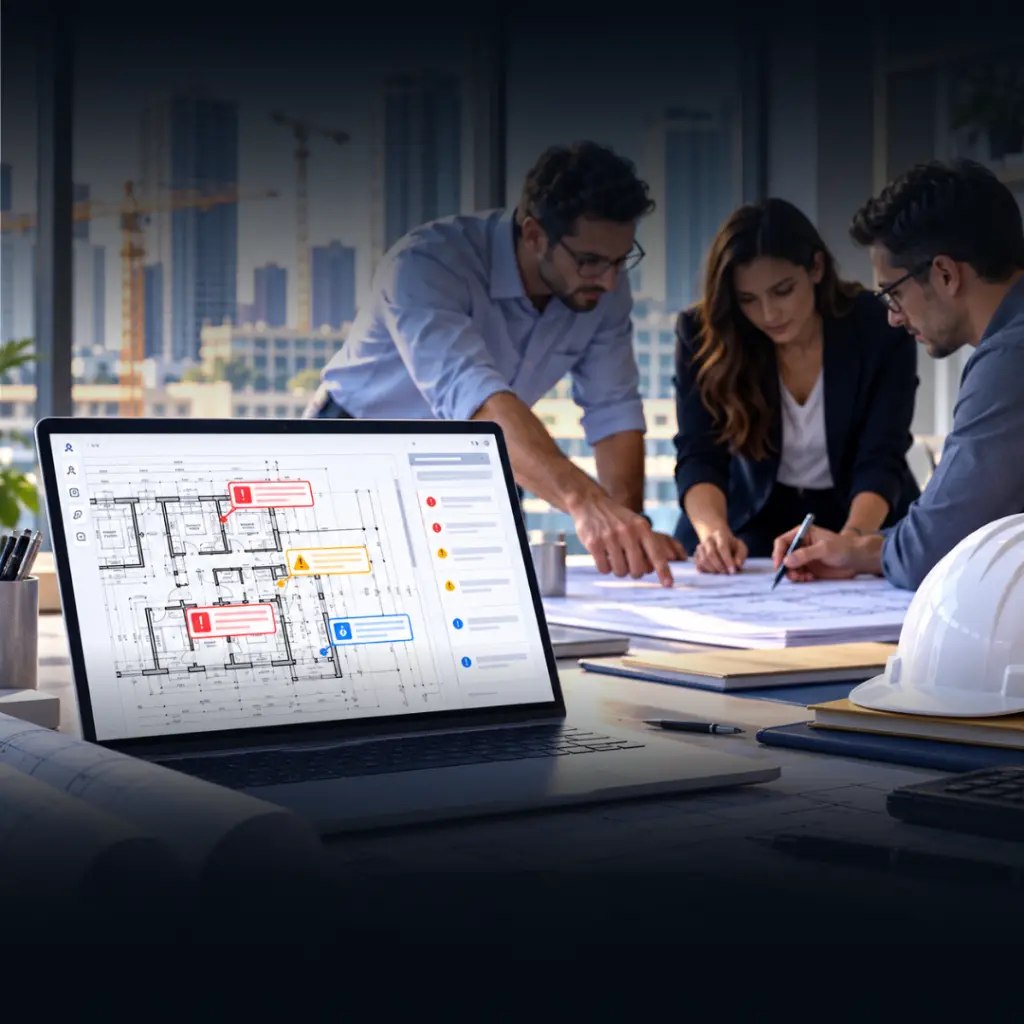
AI plan review software can process construction documents, compare related information, and help surface potential issues for professional evaluation.
Instead of manually moving between hundreds of pages, AI can assist in identifying conditions such as:
AI is also valuable during revisions. When drawings change, revised documents can be reviewed again to help determine whether previous issues were addressed and whether the changes introduced new coordination or compliance concerns.
The best AI construction plan review software for architecture and engineering firms should be evaluated by how well it supports real construction workflows.
Construction drawings are more than text inside PDFs. Plans, schedules, calculations, notes, and details work together.
A useful platform should evaluate relationships between construction documents rather than simply searching for keywords.
Design professionals need to understand what the potential issue is, where it occurs, which requirement applies, and what should be reviewed or corrected.
Findings supported by code citations and corrective direction are more useful than generic warnings because architects and engineers can verify and act on them.
A platform should help teams evaluate relationships across architectural, structural, MEP, fire protection, accessibility, life safety, and other project information.
It should also support repeated reviews as drawings change throughout design and permitting.
Technology should reduce work rather than create another administrative burden.
A&E firms should be able to incorporate AI findings into their existing QA/QC process without completely redesigning their workflow.
PlanCheckPro.ai is designed around construction documents, building codes, plan coordination, permitting, inspections, and the actual plan-review process.
The workflow is straightforward:
The architect or engineer remains responsible for evaluating the findings and determining the appropriate design solution.
PlanCheckPro.ai was developed around how construction documents are actually prepared, coordinated, reviewed, and submitted for permits.
Compliance information can appear across plans, schedules, notes, calculations, and details. PlanCheckPro.ai is designed to evaluate construction drawings using building-code and plan-review logic rather than treating each page as an isolated document.
The goal is not to produce a long list of vague warnings.
PlanCheckPro.ai is designed to identify potential issues, provide applicable code citations, and give corrective direction so design professionals can verify the requirement and determine the appropriate response.
Findings can be exported into Excel so teams can assign responsibilities, document responses, track corrections, and incorporate results into existing quality-control procedures.
PlanCheckPro.ai is a quality-control tool. Architects and engineers remain responsible for evaluating the results, applying professional judgment, and determining the final design solution.
Design revisions happen constantly.
Moving a wall or door may affect accessibility, egress, fire ratings, hardware, life safety, or coordination with other disciplines. A relatively small design change can therefore require a much broader compliance review.
For architecture and engineering firms, AI plan review can provide several benefits:
For mid-sized firms, AI can also help expand review capacity when experienced architects and engineers are already balancing design, calculations, project management, client communication, and other responsibilities.
No. AI plan review should support professional judgment, not replace it.
The architect or engineer still needs to determine whether a finding applies, interpret project-specific conditions, evaluate the appropriate solution, and remain responsible for the final construction documents.
AI can support the repetitive and time-consuming portions of review so professionals can focus more attention on complex conditions that require experience and judgment.
AI plan review can be especially valuable before permit submission and after significant design revisions.
Finding potential issues earlier gives the project team an opportunity to address them while the drawings are still under its control.
A problem identified during design may require a relatively straightforward revision. The same issue discovered during permitting can result in another review cycle. If discovered during construction, it could lead to redesign, field corrections, change orders, or schedule impacts.
A&E firms should look for software that understands construction documents, supports cross-discipline review, provides verifiable code citations, handles revisions, produces actionable findings, and fits into existing QA/QC workflows.
PlanCheckPro.ai is designed specifically around these construction plan-review requirements.
AI can analyze construction drawings for potential code violations, missing information, and coordination issues. Findings should still be evaluated by qualified architects, engineers, or code professionals.
No. Automated review can reduce repetitive manual checking and provide another quality-control resource, but professional judgment remains necessary.
Yes. Revised drawing sets can be analyzed again to identify potential compliance and coordination concerns after design changes.
AI plan review can help identify potential issues before permit submission. Catching those issues earlier may reduce avoidable comments and repeated review cycles, although no software can guarantee a comment-free building department review.
Effective AI construction plan review software should help A&E firms identify potential problems earlier, cross-reference complex drawing sets, review revisions more efficiently, and provide findings that professionals can verify and act on.
PlanCheckPro.ai was designed to bring AI into the construction plan-review process while keeping architects and engineers at the center of decision-making.
For firms facing complex codes, larger drawing sets, tighter schedules, and frequent revisions, automated code compliance review provides another opportunity to identify issues before they become permit comments, RFIs, redesigns, or field corrections.