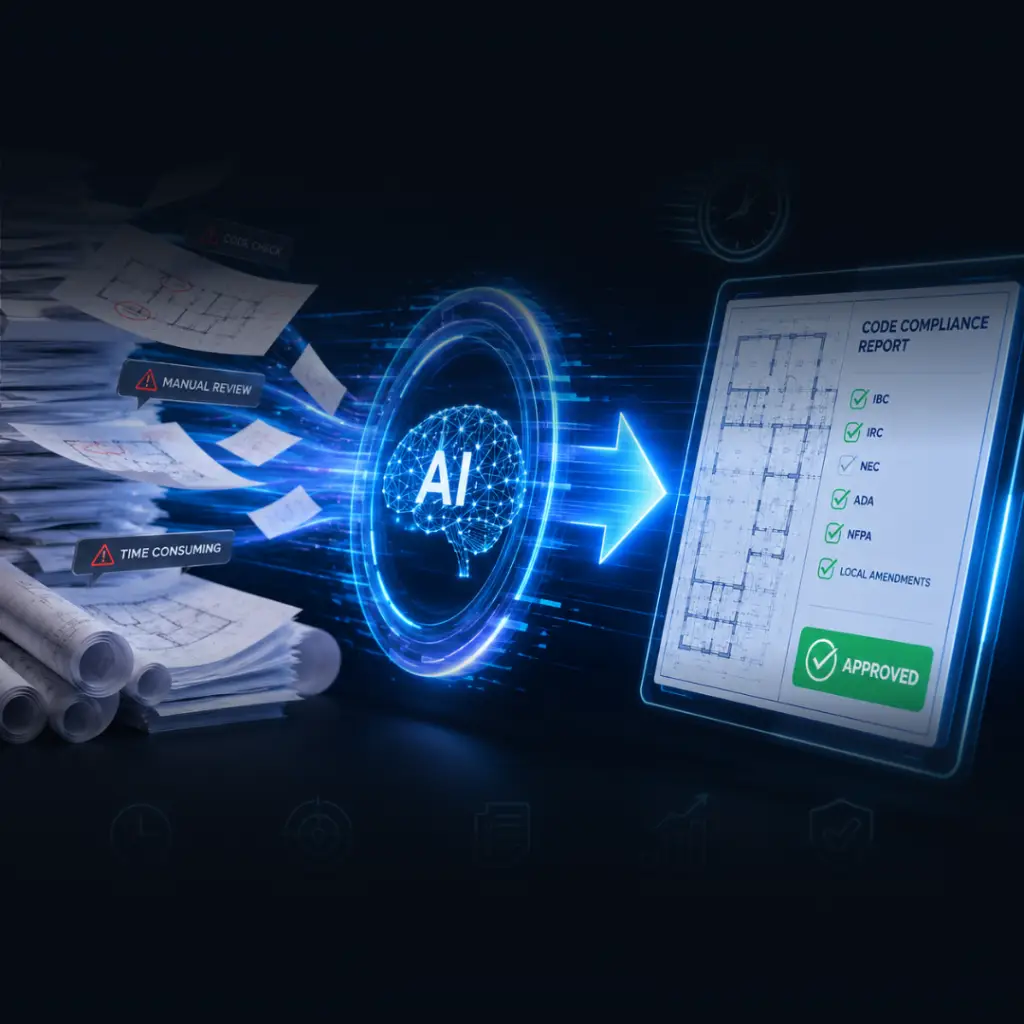
Traditional plan review is slow because it depends on a qualified person manually moving through hundreds of drawing sheets, locating relevant information, cross-referencing details, applying code requirements, and documenting every potential issue.AI plan review platforms accelerate that process by analyzing the drawing set as a whole rather than requiring the reviewer to evaluate each sheet and condition one at a time.
They review complete drawing sets in minutes instead of days
A comprehensive manual code review can take days, depending on the size and complexity of the project. Large commercial and multifamily projects may contain hundreds of architectural, structural, mechanical, electrical, plumbing, fire-protection, and life-safety sheets.The reviewer must locate critical project information, including:
Occupancy classifications.
Construction types.
Building heights and areas.
Fire-resistance ratings.
Occupant loads.
Exit locations and capacities.
Accessibility requirements.
Plumbing fixture calculations.
Mechanical and electrical system information.
An AI platform can process the drawing set and begin identifying potential compliance issues in a fraction of the time required for a fully manual review.This does not mean the architect or engineer should accept every result without evaluation. It means the professional receives a structured first review much faster and can focus attention on the conditions that require judgment.
They cross-reference drawings automatically
One of the most time-consuming parts of manual plan review is comparing information across different sheets and disciplines.A reviewer may need to compare a floor plan with a life-safety plan, door schedule, wall-type detail, reflected ceiling plan, electrical plan, and fire-protection drawing to determine whether one condition complies.AI can assist by identifying and comparing related information throughout the drawing set.For example, the platform may identify that:
A fire-rated wall shown on one sheet is not consistently identified elsewhere.
A door width does not appear to support the required exit capacity.
A room name or occupancy designation differs between plans.
A required accessibility feature is missing from the related details.
A penetration through a rated assembly lacks an appropriate detail.
The occupant load does not appear consistent with the number or width of exits.
Instead of requiring someone to repeatedly move between sheets and remember every related condition, the system helps organize and surface those potential conflicts.
They re-check revisions without restarting the entire process
Design documents change constantly.A building department comment may require a revised floor plan. An owner may change the use of a space. A consultant may relocate equipment. A revised wall or door location may affect egress, accessibility, fire ratings, or coordination with other disciplines.During a traditional revision review, the reviewer must determine what changed, confirm whether previous comments were addressed, and evaluate whether the revisions created additional issues elsewhere.AI plan review platforms can process the revised documents and repeat the compliance analysis without requiring the reviewer to manually restart the entire review.This is especially valuable on projects with multiple submission cycles. The design team can evaluate each revised set before resubmitting it, reducing the likelihood that one correction creates another problem.
How Does PlanCheckPro.ai Work?
PlanCheckPro.ai is designed to provide architects, engineers, contractors, developers, and code professionals with an additional quality-control review of construction documents.The process is straightforward:
The user uploads the construction drawing set.
PlanCheckPro.ai analyzes the drawings against applicable building codes and standards.
The system reviews information across multiple sheets and disciplines.
It identifies potential code violations, missing information, and coordination issues.
The user receives organized comments with code citations and corrective direction.
The results can be exported into Excel for review, assignment, response, and tracking.
Revised plans can be uploaded and reviewed again before the next submission.
The design professional remains responsible for evaluating the findings and determining the appropriate correction. PlanCheckPro.ai supports professional judgment; it does not replace it.
What Makes PlanCheckPro.ai Stand Out?
There are many products using artificial intelligence, but construction code review requires more than a general-purpose AI model.PlanCheckPro.ai was developed around the way construction documents are actually prepared, coordinated, reviewed, and submitted for permits.
It is construction-specific
Generic AI may understand words appearing on a drawing, but it may not understand how construction information is connected.PlanCheckPro.ai is designed to evaluate construction drawings using building-code and plan-review logic. It recognizes that compliance information may be distributed across plans, schedules, notes, calculations, and details.That industry-specific focus helps produce findings that are more relevant to architects, engineers, contractors, and code professionals.
It provides code citations and corrective direction
A vague warning is not useful to a design team.The user needs to know what the issue is, where it appears, which code requirement applies, and what should be reviewed or corrected.PlanCheckPro.ai is designed to produce actionable findings supported by applicable code citations. That allows the design professional to verify the requirement and make an informed decision.
It fits into existing design workflows
Design teams do not need another complicated system that creates more administrative work.PlanCheckPro.ai produces an organized output that can be exported into Excel. Teams can use the results during quality-control meetings, assign comments to consultants, document responses, and track corrections before permit submission.The goal is to support the team’s existing process rather than force the team to completely change how it works.
It delivers consistent reviews
Human review quality can vary based on workload, experience, fatigue, and available time.PlanCheckPro.ai applies a consistent review process each time a drawing set is analyzed. That gives firms a repeatable quality-control standard across projects, offices, reviewers, and revision cycles.
It was built from real plan-review experience
My background includes engineering, inspections, private-provider services, permitting, and working directly with building departments and design teams.I have seen projects delayed by issues that were relatively minor but were not discovered until the plans reached the building department. I have also seen revisions intended to resolve one comment create a new conflict somewhere else in the drawing set.PlanCheckPro.ai was created to address those real problems.The purpose is not to generate an impressive volume of comments. The purpose is to identify meaningful issues early enough for the project team to act on them.
The Main Benefit: Finding Problems Earlier
The greatest advantage of automated code compliance review is not simply speed. It is the ability to move problem identification earlier in the project.A design issue found before permit submission may require a straightforward drawing revision.The same issue found during permitting may cause another review cycle and several weeks of delay.If it is not discovered until construction, it may require redesign, demolition, replacement materials, additional inspections, change orders, and schedule impacts.PlanCheckPro.ai helps design teams identify potential issues while they are still easier and less expensive to correct.That results in:
Faster internal quality-control reviews.
Fewer avoidable permit comments.
Better coordination between disciplines.
Faster review of revised drawing sets.
Fewer RFIs and construction conflicts.
More predictable permitting schedules.
Greater confidence before submission.
The platform does not replace the knowledge and judgment of licensed professionals. It gives those professionals a faster and more consistent way to review complicated drawing sets and focus their expertise where it matters most.