The Future of AI in Engineering | How AI Is Transforming Plan Review & Permitting
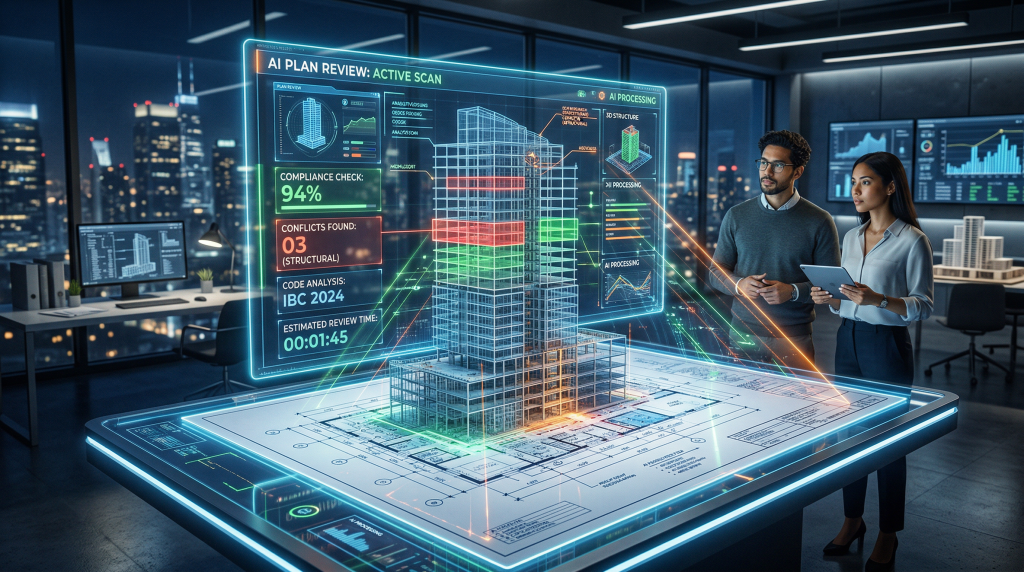
The Problem No One Wants to Admit If you’ve spent any time in engineering, construction, or development, you already know where projects begin to slow down. It’s not usually the design. It’s not the talent of the team. And it’s rarely the vision behind the project. It’s the moment when everything is ready to move forward—and the project enters plan review. At that point, timelines become uncertain. Weeks can pass without clarity. Feedback comes in waves rather than in a clear, structured format. And what should have been a straightforward approval process turns into a cycle of waiting, revising, and resubmitting. Over time, this has become so normalized that most teams simply build delays into their expectations. But the reality is much more serious: plan review is one of the most significant hidden bottlenecks in the entire construction lifecycle. ______________________ Why the Traditional System Is No Longer Sustainable For decades, plan review has relied heavily on manual processes. Skilled professionals carefully examine drawings, compare them against building codes, and identify issues that need to be resolved before approval. While this approach has worked, it comes with limitations that are becoming increasingly difficult to ignore. Manual review is inherently time-consuming. It is also inconsistent, as different reviewers may focus on different aspects of a plan. Most importantly, it is reactive—issues are discovered only after submission, which leads to multiple rounds of revisions. As projects become more complex and timelines become tighter, this reactive model creates compounding delays. Each revision cycle adds days or even weeks, and every delay affects not only the schedule but also the budget, coordination efforts, and overall project momentum. The industry has tolerated this for years, but it is no longer aligned with the pace at which modern projects need to move. ______________________ The Turning Point: AI Enters the Workflow The introduction of artificial intelligence into engineering workflows represents a fundamental shift, not just an incremental improvement. Unlike previous tools that focused primarily on drafting or visualization, AI is now being applied directly to one of the most critical stages of the process: plan review. This matters because plan review is uniquely suited for AI. It involves structured rules, defined codes, and repetitive validation tasks—all areas where intelligent systems can perform efficiently and consistently. Instead of replacing engineers or reviewers, AI enhances their capabilities by handling the most time-intensive and repetitive aspects of the job. This allows professionals to focus on higher-level decision-making while the system ensures that foundational checks are completed quickly and accurately. ______________________ What AI-Powered Plan Review Actually Does At a practical level, AI-powered plan review transforms how construction documents are evaluated before and during the approval process. Rather than relying solely on manual review after submission, AI systems analyze drawings as soon as they are uploaded. They interpret layouts, identify relevant elements, and compare them against applicable codes such as the Florida Building Code (FBC) and the National Electrical Code (NEC). The system then flags potential issues, highlights inconsistencies, and provides detailed feedback that includes direct references to the relevant code sections. In many cases, it also suggests corrective actions, allowing teams to address problems immediately instead of waiting for formal review comments. The result is a more proactive workflow. Instead of submitting plans and hoping they pass, teams can validate and refine their work before submission, significantly increasing the likelihood of first-round approval. ______________________ From Reactive to Predictable: The Real Shift The most important change AI brings is not just speed—it is predictability. Traditional workflows are reactive. Teams submit plans, wait for feedback, and then respond to issues as they arise. This creates uncertainty at every stage, making it difficult to plan timelines with confidence. AI introduces a proactive approach. By identifying issues early, it allows teams to resolve problems before they impact the approval process. This reduces the number of revision cycles and creates a more controlled, predictable path from design to approval. In practical terms, this means fewer surprises, fewer delays, and a much clearer understanding of how long a project will take to move forward. ______________________ The True Cost of Delays (Beyond Fees) When people think about plan review costs, they often focus on permit fees or review charges. However, the real cost of traditional plan review goes far beyond these visible expenses. Delays in approval can push back construction schedules, which in turn affects labor planning, material procurement, and overall project timelines. Extended timelines increase overhead costs and can delay revenue generation, especially for developers working on time-sensitive projects. Additionally, each revision cycle requires coordination among multiple stakeholders, including engineers, architects, and consultants. This not only consumes time but also introduces opportunities for miscommunication and further delays. Perhaps most importantly, delays create uncertainty. When timelines are unpredictable, it becomes difficult to make strategic decisions, allocate resources efficiently, or commit to deadlines with confidence. How AI Reduces Both Time and Cost AI-powered plan review addresses these challenges at their root. By identifying issues early, it reduces the need for multiple revision cycles. By accelerating the review process, it shortens the overall timeline. And by providing clear, code-based feedback, it minimizes ambiguity and improves communication between teams. The cumulative effect is significant. Projects move forward faster, teams spend less time on rework, and organizations gain greater control over both timelines and budgets. In many cases, the value of AI is not just in reducing direct costs but in preventing the cascading effects of delays that can impact an entire project. ______________________ The Role of PlanCheckPro.AI in This Transformation As the industry begins to adopt AI more widely, the difference between generic tools and purpose-built solutions becomes increasingly important. PlanCheckPro.AI stands out because it is specifically designed for real-world permitting workflows. It focuses on the areas where teams experience the most friction and delivers practical solutions that can be integrated without disrupting existing processes. The platform validates plans against key codes such as FBC and NEC, generates detailed reports with code citations, and delivers
What Does AI-Powered Plan Review Do? | The Future of AI in Engineering
For years, the industry accepted a painful routine as “normal.” Upload the plans. Wait. Hear nothing. Follow up. Wait again. Get comments. Rework the set. Resubmit. Hope this time the reviewer catches everything that matters and nothing gets missed. Build extra time into the schedule because everyone knows reviews rarely move as fast as the project needs them to. The strange part is that we all got so used to the friction that many teams stopped questioning it. But AI-powered plan review is forcing that question now: What if the slowest part of the process never had to stay slow? ____________________ So, what does AI-powered plan review actually do? At its core, AI-powered plan review pre-screens or analyzes construction documents against building codes, rules, and completeness requirements, then flags possible issues before or during the review cycle. In practice, modern tools are being used to identify missing items, catch noncompliant elements, surface exact code references, and speed up compliance checks — while still keeping humans responsible for final judgment. That last point matters: public guidance from Florida city leaders explicitly frames AI as a support tool, not a replacement for final decision-making. That means AI is not magic. It is leverage. It does the repetitive, time-heavy, consistency-sensitive work that humans should not have to do manually over and over again. ____________________ We are already seeing the shift in real permitting environments This is not theoretical anymore. The Florida League of Cities highlighted multiple city and county examples showing AI already being used in permitting workflows. In Altamonte Springs, a pilot reportedly reduced initial reviews that previously took days down to minutes. In Gainesville, an AI-driven plan review system generated detailed reports within one to two days and helped reduce resubmissions caused by overlooked errors. In Hernando County, zoning reviews that once took weeks were reported as being completed in days after the implementation of an AI-powered review tool. That is the future of AI in engineering in one picture: fewer repetitive checks by hand, faster identification of issues, better-prepared submissions, and more human attention reserved for judgment calls instead of paperwork triage. ____________________ Why this matters to engineers, architects, developers, and reviewers Engineering teams do not lose time only in “review.” They lose time in uncertainty. They lose time when no one knows whether a submission is clean enough. They lose time when design teams wait for comments that could have been found earlier. They lose time when reviewers spend energy on avoidable errors instead of the highest-value technical decisions. That is why the best AI plan review tools matter. They do not just accelerate the end of the process. They improve the quality of the process upstream. PlanCheckPro.AI’s public materials describe this clearly: it analyzes uploaded construction drawings against the Florida Building Code and NEC, connects flagged issues to the applicable code sections, and provides recommended corrective actions in structured reports. The company positions the tool as a way to reduce RFIs, improve first-round approvals, and help teams move from design to approval faster and smarter. That is not “AI replacing experts.” That is AI removing preventable drag from expert work. ____________________ The future of AI in engineering is augmentation, not replacement One of the strongest themes across current public-sector and plan-review discussions is that AI works best when it augments professionals rather than pretending to replace them. e-PlanSoft recently framed AI in plan review as a way to reduce rework, prevent misses, and streamline resubmittals while keeping human judgment central. Florida city guidance says the same thing: pair AI with human oversight, start with pre-screening, and track actual outcomes such as reduced review times, fewer resubmittals, and staff hours saved. That is exactly why tools like PlanCheckPro.AI are compelling. They fit the way the industry actually works. Reviewers still review. Engineers still engineer. Architects still design. But the process becomes faster, cleaner, and more predictable. ____________________ Why PlanCheckPro.AI is a strong bet in that future If you are writing about “the future of AI,” you do not want vague futurism. You want a concrete example of where the market is headed. PlanCheckPro.AI is that example. It is publicly positioned around a real pain point — delayed, inconsistent plan review — and a real operational benefit: reviews in hours, direct code citations, corrective-action reporting, and workflow support for developers, architects, engineers, GCs, AHJs, and private providers. It also sits inside a timely Florida legal context, because HB 683 gave new legitimacy to software-based plan reviews in private-provider workflows. That is what the future of AI in engineering looks like: not hype, but applied usefulness. Not replacing professionals, but helping them stop wasting time on work software can be the first.